
What a Washington Resident Lookup Covers
A Washington resident lookup is a sequence of role checks. A parcel record names an ownership relationship. A voter record reflects registration under current Utah rules. A court row names a party in a case. A license or business filing names a credential or entity role. Archives and oral histories point to historical people. The table keeps those meanings apart.
| Record | What It Confirms | Where to Search | Access |
|---|---|---|---|
| Assessor, Recorder, GIS | Property owner or record party, parcel, situs and mailing relationship | Washington County viewers | Public search; copies and redactions vary |
| Voter information | Allowed name, address, status, party, precinct and participation fields | Utah voter route and County Clerk | Scope, purpose, fee and privacy rules |
| Court cases | Party, case number, type, filing date, hearings, history, disposition | Utah Xchange | Billable search or terminal; protected cases excluded |
| Vital indexes and certificates | Historical birth, death, marriage, divorce, burial or family clues | OVRS and Utah State Archives | 100/50/75-year rules and eligibility |
| Business and licenses | Entity, principal, agent, permit, license, profession and status | Utah Commerce, DOPL, Washington City | Role and business address are not residence proof |
| Archives and oral history | Historical people, offices, institutions and memories | WCHS, Utah Tech, Archives | Finding aids and attribution required |
Start with the narrowest clue. Use GIS and the Assessor for an address, Xchange for a public case, OVRS or Archives for a vital question, DOPL for a credential, and WCHS or Utah Tech for a historical subject. When a portal is incomplete or stops at a login, make a defined request to the custodian. A name-only match is never enough.
The Utah Xchange records overview describes public case access and exclusions.
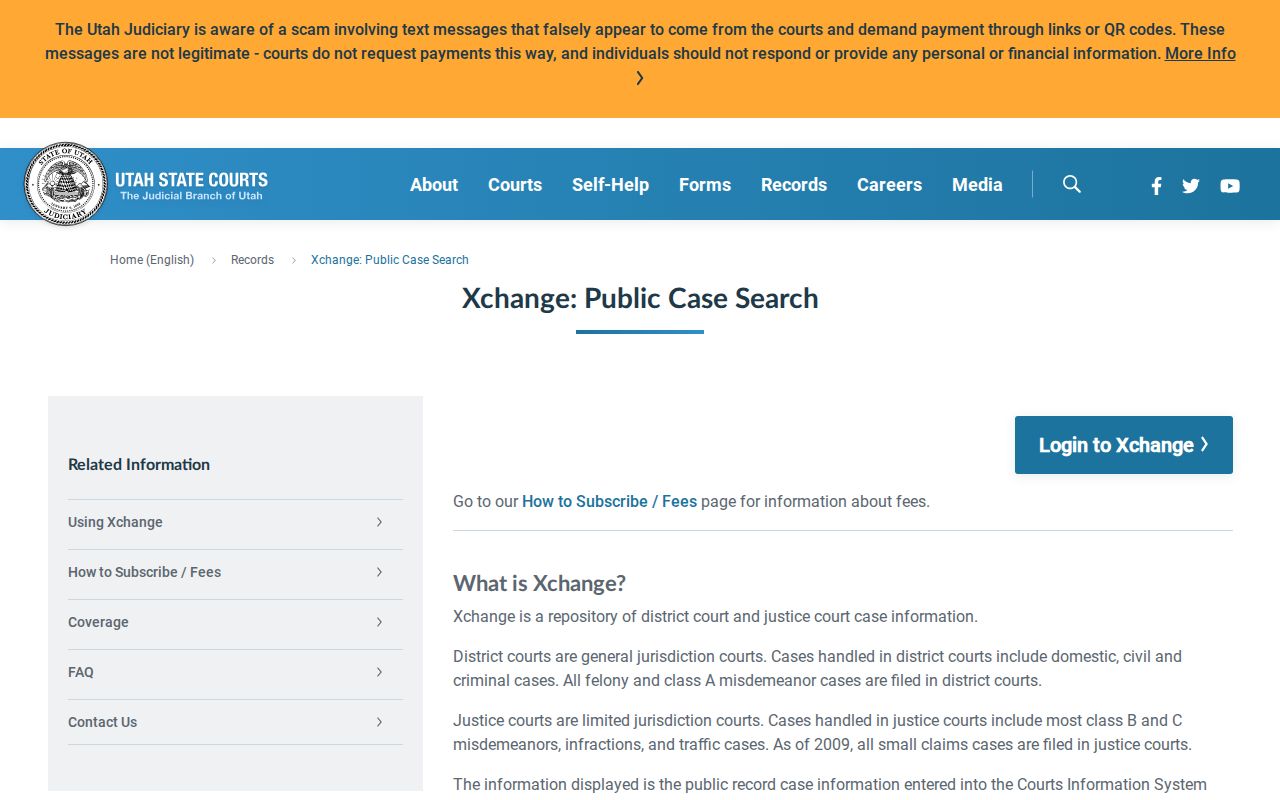
It is a court-record route, not a general Washington resident list.
Verifying a Washington Resident's Records
Verification means matching role, date, jurisdiction, and record identifier. It does not mean collecting every fragment about a person. If an address is the starting point, map it to a parcel, then inspect the Assessor and Recorder relationship. If a name is the starting point, use the narrowest court, vital, business, or historical route. Keep a source card for each result.
- Write the name, known date range, role, and Washington connection. Keep variants and spelling changes visible.
- Anchor the record with an official jurisdiction, parcel, organization, case number, spouse or parent only when publicly supported.
- Search Utah Xchange, the state voter route, DOPL, or the relevant Archives index with those limits, then save the source date.
- Compare a second independent record, such as a death index with cemetery or obituary evidence, or a deed with parcel data.
- Order a certified copy only through the custodian when eligibility, identification, relationship, fee, and purpose rules allow it.
- Docket
- The court’s running case record, including filings, events, orders, and status entries.
- Index versus image
- An index points to a record; an image is the scanned or displayed document and may require a fee.
- Certified copy
- A custodian-attested copy issued under that office’s request and eligibility rules.
- Disposition
- The recorded outcome or current case status, which must be read before summarizing a court result.
Utah Xchange Narrows a Name
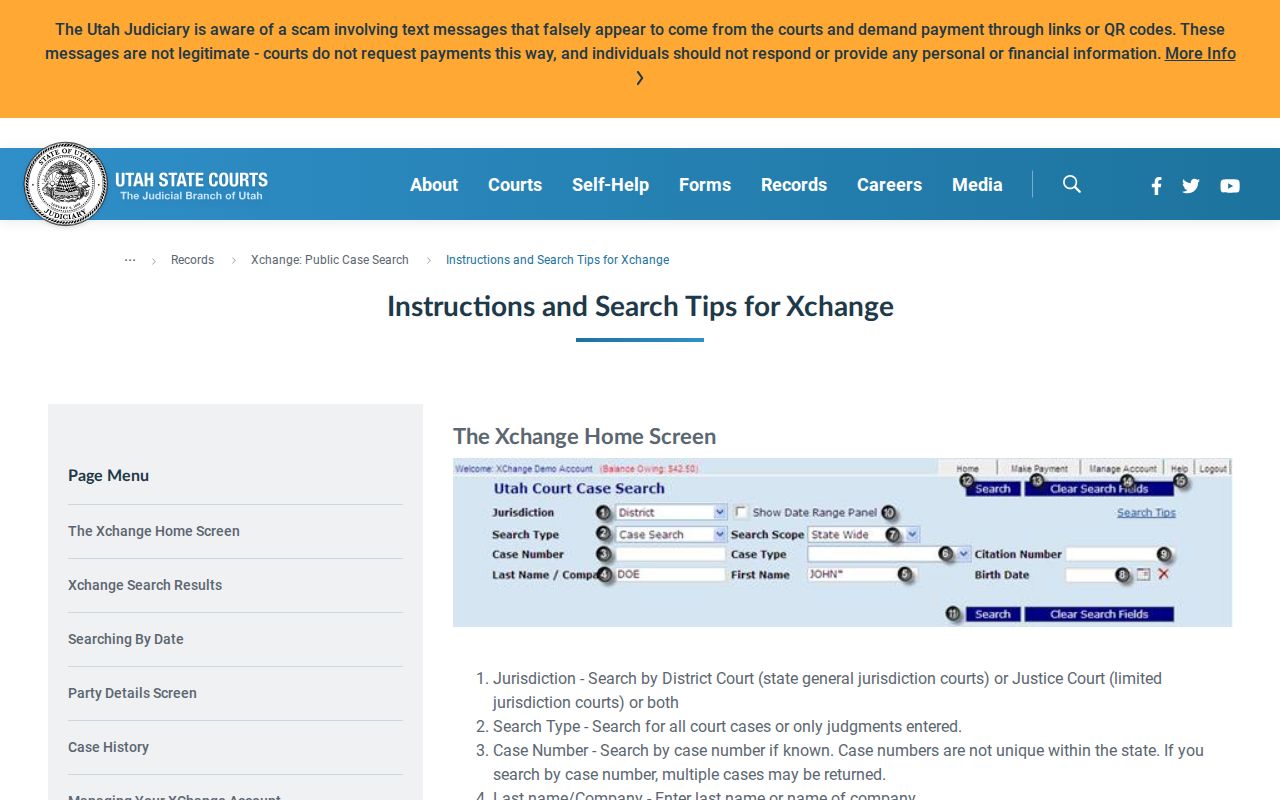
Utah Xchange search help lists jurisdiction, search type, case number, last or company name, first name, case type, statewide, county or court scope, birth date, citation number and location, and date range. A broad name search can return up to 500 results, so court and date settings are part of the finding. Xchange may show court location, case type and number, filing date, party, history, events, documents, judgments, and purchase links.
Washington City Justice Court supplies local procedure and contact, while the County Justice Court and Fifth District Court sit in the wider county trail. Public terminals and the State Law Library are alternate access channels. Most district courts were in CORIS by late 1998, but justice coverage varies. Sealed, juvenile, expunged, adoption, civil-commitment, and other private matters are not ordinary public search results.
The Xchange guest route shows the account and fee path.
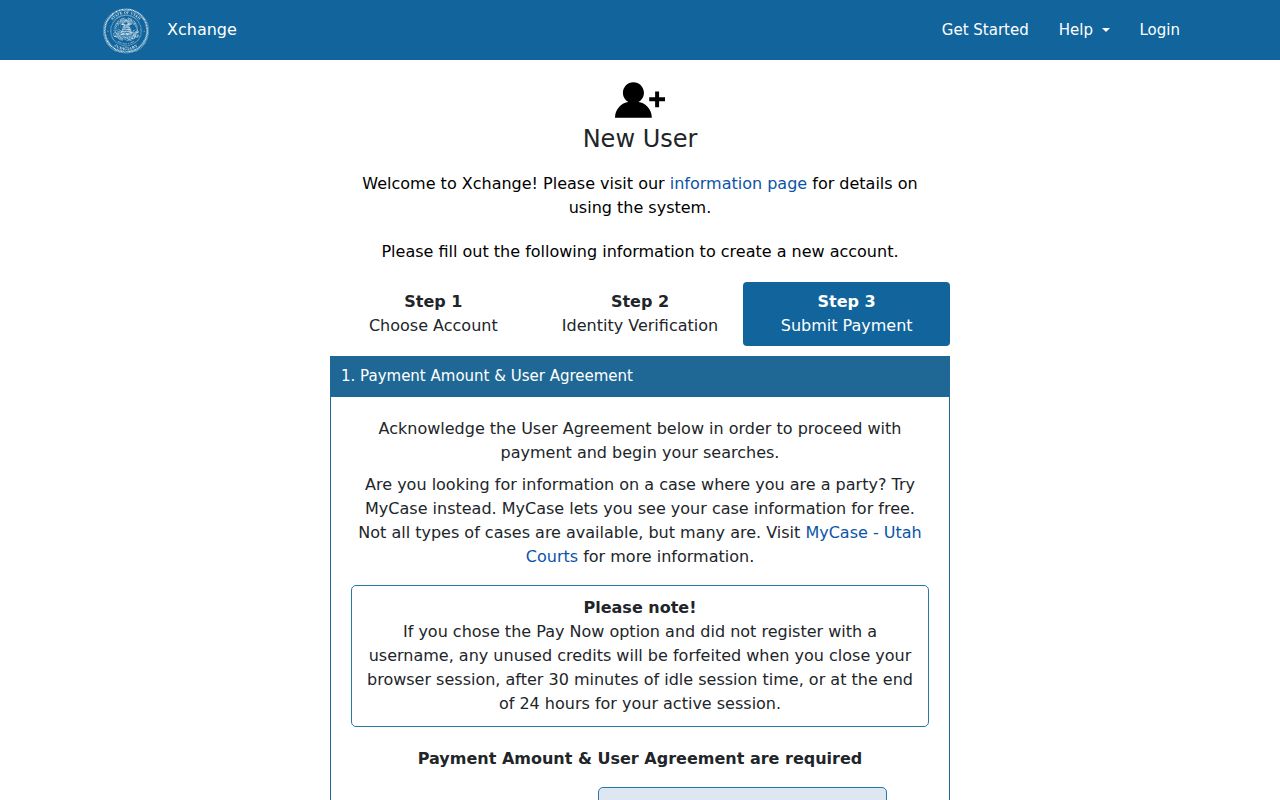
Search and document charges should be checked on the live court service before use.
| Result field | Safe reading |
|---|---|
| Party and party code | Role in a case, not a finding of wrongdoing. |
| Case history and documents | Procedural events and source documents, with access limits. |
| Disposition or judgment | Outcome that must be checked separately from an arrest or filing. |
Washington Vital Records Have Windows
Utah Code 26B-8-125 governs the timing of vital-record access. Births generally become public after 100 years, deaths after 50 years, and other vital records after 75 years, subject to statutory exceptions. OVRS handles current online, mail, and in-person requests with identification, eligibility, and fees. A certified copy is not the same thing as an Archives index.
The Utah death index is the historical name-search route.
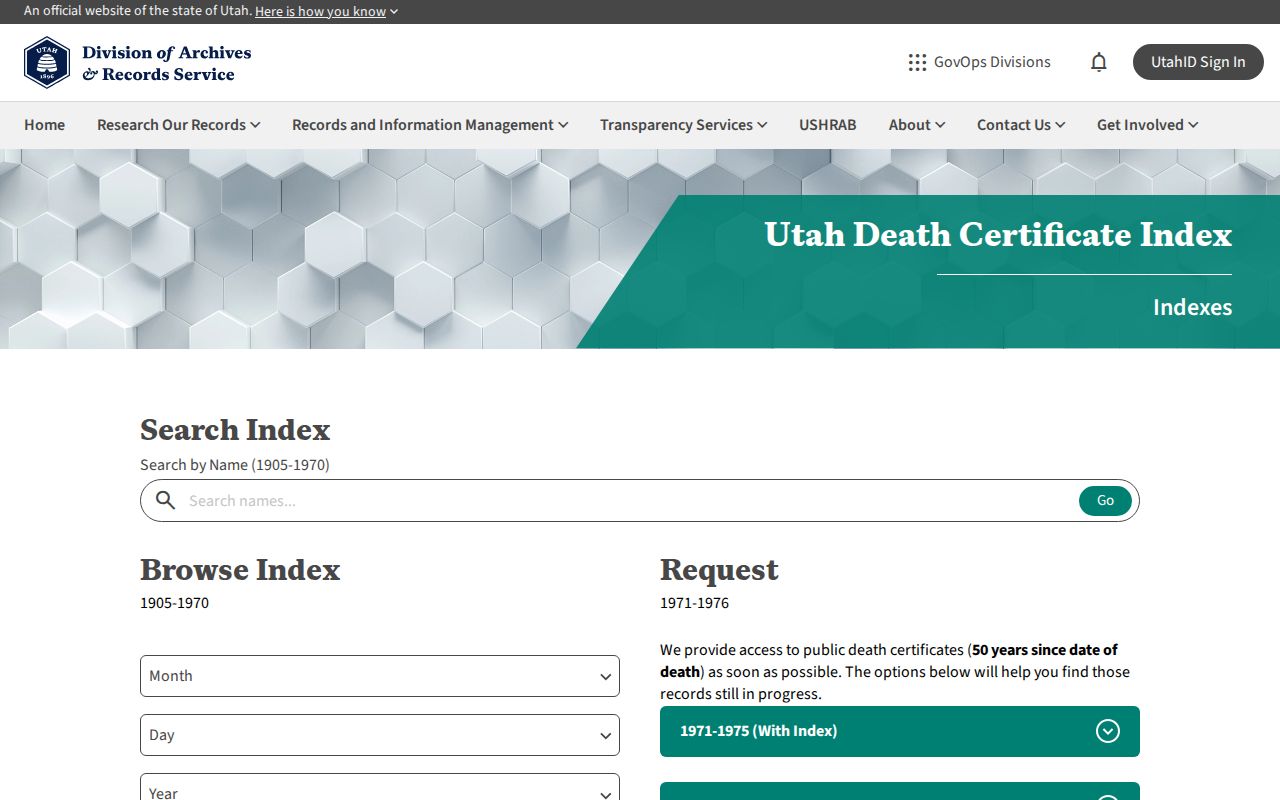
Its residence and burial fields can support historical matching, but the index is not a certified death record.
The Utah death index supports name search or browse for 1905–1970 and describes residence, burial, parents, birth, death date and county, cause, and other fields. Washington County birth registers, Series 3166, cover 1898–1905. The marriage/divorce request form covers 1978–2010 and limited marriages from 2011 forward, with spouse, place/date, applicant relationship and proof, copies, fee, and signature fields.
Washington Work and License Roles
Business and professional records can help verify a public role, but they should not be used to infer a home. Utah’s business list supports entity type, NAICS, ZIP, recent changes, new registrations, and status filters. DOPL searches by name, profession, or license number and supports beginning-with or containing matches. Construction registry fields include profession, classification, specialty, company, license number, city, state, and ZIP. Notary search adds business city, ZIP, languages, attorney, escrow, and remote filters.
Washington City business licenses cover commercial or industrial, home occupation, mobile food, out-of-area, and solicitor categories. No public searchable city license register was located, so use GRAMA for a defined record. Preserve the role: principal, registered agent, licensee, permit applicant, contractor, or owner. A business address is a business record, not a current residence.
Washington’s Historical Person Leads
WCHS, Utah Tech, and Archives are useful when a name belongs to Washington history rather than a current search. WCHS holds dated gazetteers, Washington County News, and an evolving subject library. Utah Tech’s WASH-046 collection includes biographical files, membership rosters, newsletters, minutes, maps, photos, and official ballots from 1981–2000. Oral histories include 441 Voices of Remembrance tapes within a larger regional collection of more than 1,000.
Use the source type carefully. A transcript identifies a speaker and interview date. A former-officeholder list identifies a civic role. A newspaper item may be an obituary, notice, advertisement, or social visit. A historic schoolhouse or Cotton Mill mention can anchor a research lead without becoming a current address claim.
Legal Limits on a Resident Lookup
Utah public-record access is divided among GRAMA, vital-record statutes, court rules, voter privacy, Safe at Home, victim-services guidance, and federal restrictions on driver information. Public data can still have a narrow purpose. Protected voter fields include full date of birth, driver or state ID, Social Security number, email, and phone. Sealed, juvenile, expunged, adoption, and private court matters remain restricted. Safe at Home provides a substitute mailing address while the actual address stays protected.
Lawful use. A Washington resident lookup belongs to personal, lawful research, family history, civic records, or a defined property question. Repeated monitoring, approach, communication, or address aggregation that frightens or harms someone can violate Utah safety and anti-stalking boundaries.
When a record appears wrong, retain the URL, record identifier, retrieval date, and the short issue description. Send a correction question to the city, county, Archives, OVRS, DOPL, DOC, BCI, or court clerk that owns the source. “Not located in the searched official source” is more accurate than “does not exist.”
The Utah vital-records access page explains the official request route.
Use that route for eligibility and copy questions rather than reconstructing restricted facts from public fragments.
Make a Washington Search Useful
A useful result can be small. Show the agency, record type, source date, jurisdiction, name as written, role, status or disposition, and a confidence note. A Washington County Recorder instrument naming a grantee is not proof that the grantee lives at the parcel. A WCHS transcript mentioning a person in 1995 is not a current resident record. An inmate roster is a time-stamped custody snapshot, not a city residence list.
Stop when the next step would require protected information. Do not combine a precise home address, voter status, court history, custody entry, professional license, and family relationship into one profile. The record role is the answer. When the person’s goal shifts from one name to the people along a road, use the Washington street directory for the address method rather than expanding a one-person file.